
Given Beyond the Times' (BTT) mission statement — working responsibly with AI to offer an honest reportage of current events — especially those stories that offer pathways towards a sustainable and collaborative future between the global human community and the natural world — let's explore the cost vs benefits of AI, since in the four years that this technology has become mainstream, it has already noticeably impacted the environment in no small way.
An Overview
AI Energy and Water Consumption

The numbers on the consumption side are staggering and accelerating. According to the International Energy Agency, data centers consumed approximately 460 TWh (terawatt-hour) of electricity in 2024 — roughly 1.5% of all global electricity.[18] One watt-hour (Wh) means using one watt of power for one hour. A terawatt-hour means using a trillion watts in an hour.
By 2026, that figure is projected to land somewhere between 650 and 1,050 TWh.[18] For context, if data centers were a country, they would already rank as the fifth-largest energy consumer on Earth, slotting in between Japan and Russia.
At the individual query level, single ChatGPT query consumes approximately 2.9 Wh of energy — the equivalent of running a lightbulb for about 20 minutes.[41] Google's AI Overviews add roughly 10 Wh per query, compared to 0.3 Wh for a non-AI Google search. Alphabet's own board chair acknowledged to Reuters that an AI-powered search exchange can cost 10 times more than a traditional search.[37]
All this energy consumption yields a lot of heat. Large data centers can consume up to 5 million gallons of water per day for cooling.[38] Researchers at the University of California, Riverside estimate that each 100-word AI prompt uses roughly one bottle of water. Training GPT-3 at Microsoft's U.S. data centers alone evaporated an estimated 700,000 liters of clean freshwater.[14]
In Loudoun County, Virginia — home to more data centers than any other county in the world — data center water consumption grew over 250% between 2019 and 2023, approaching 10% of the county's total supply, and most facilities still draw from treated drinking water.[25]
In short, AI is ravenous for energy and water, both limited and precious resources. As a result, residential electricity bills are already climbing, and likely to keep going up. [44]
Let's see if the return makes its hunger worth it:
Effects on Productivity

At the individual worker level, Federal Reserve research found that generative AI saves workers an average of about 2.2 hours per week for a standard 40-hour schedule, or roughly one full workday per month.[31]
At the enterprise level, NVIDIA's 2026 State of AI survey found that 88% of respondents said AI increased their annual revenue, with nearly a third reporting gains greater than 10%.[5] Similarly, 87% said AI helped reduce annual costs.Companies reported an average 11.5% net productivity increase over the past 12 months.
Yet U.S. productivity growth actually slowed in the first quarter of 2026.[54] This echoes what economists call the "Solow Paradox" — the same pattern observed during the early internet era, when transformative technology did not yet reflect an increase in productivity statistics. The question is whether AI follows the same pattern or a completely different one.
And the gains are distributed remarkably unevenly. PwC's 2026 AI Performance Study found that nearly three-quarters of AI's economic value is captured by just one-fifth of organizations. Goldman Sachs data shows that while 77% of enterprises are pursuing AI initiatives, many don't know how to effectively evaluate or use the tools — resulting in significant spending without measurable return.[13]
Perhaps most sobering is what researchers at METR found when they measured actual coding productivity: experienced developers took 19% more time to complete tasks when using AI tools, even though they believed they were 20% faster.[34]
Given these statistics, is there an actual net positive and a solution to AI's water and energy impact?
Possible Solutions
Cooling Data Centers

So far direct-to-chip and immersion liquid cooling seem to be promising water-saving methods that would allow data centers to keep their cool.
In direct-to-chip cooling, a safe, non-conductive coolant circulates through cold plates attached directly to processors and other components that produce the most heat. The liquid absorbs heat at the source and transfers it to a sealed chilled-water loop, eliminating the need to cool the surrounding room air. [46]
In immersion cooling, entire servers are submerged in tanks with an electrically non-conductive liquid. In single-phase immersion, the liquid absorbs heat and is pumped through a heat exchanger. In two-phase immersion, the liquid boils at low temperature, absorbs heat through evaporation before condensing back to liquid. [46]
While more costly to initially set up and run, the long-term benefits of immersion cooling may outweigh the cost, as this method can support extremely high-power servers while lowering water and energy consumption.
In 2024, Microsoft — whose U.S. data centers evaporated an estimated 700,000 liters of water [38] — announced its Zero-Water Data Center Cooling Initiative, showing that the company viewed water-free cooling as essential for sustainable AI deployment. The hope is that Microsoft will make good with the initiative and other companies will follow suit in finding sustainable ways to maintain their data centers. [47]
An alternative solution to cooling has been to submerge data centers in the sea.
Underwater Data Centers

Back in 2018, Microsoft’s Project Natick first experimented with an underwater data center (UDC) holding more than 800 servers 117 feet below the surface off Scotland’s Orkney Islands. After hauling up the pod two years later, Microsoft found that underwater data centers “are reliable, practical and use energy sustainably.”[62]
But it is most recently China that has become the first country in the world to fully deploy a UDC off the coast of Shanghai in June of 2026, operating on offshore wind power. [63]
The initiative is the result of a collaboration between private company HiCloud Technology and state-owned China Communications Construction, with an investment of 1.6 billion yuan, or about $236 million. [63]
With an initial capacity of 24 megawatts, the facility is submerged at a depth of 10 meters, allowing seawater to be used as a natural cooling system, reducing energy usage for cooling to less than 10 percent. [63]
Recycling Waste Heat
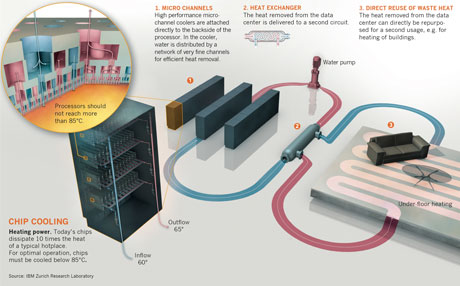
Developing ways to reuse waste heat from data centers would really help close the energy loop and reduce the need for water as a coolant, partly quenching data centers’ ravenous hunger and thirst for both.
The most established application is district heating. In Sweden, the Stockholm Data Parks initiative has positioned excess server heat as a commodity, with participating data centers selling waste heat to municipal heating utilities. [32]
In the Finnish city of Hamina, Google's data center waste heat — provided to the city for free — will soon supply 70-75% of the entire city's district heating needs, while reducing natural gas use to just 5% on the coldest days.[30] Elsewhere in Finland, Microsoft and utility company Fortum have announced a collaboration on a big data center waste heat recycling project — two Microsoft facilities in Espoo and Kirkkonummi are expected to supply roughly 40% of the district heating needs for the surrounding area. [33]
At the US Department of Energy's Oak Ridge National Laboratory in Tennessee, researchers have been studying how to optimize waste heat recovery from the Frontier supercomputer — the world's first exascale computer — using high-temperature heat pump configurations to heat the Oak Ridge campus. Their analysis found that a single megawatt of heat pump capacity could reduce over 85% of the CO2 emissions that would otherwise come from natural gas boilers.[35] Microsoft has also discussed using waste heat to power direct air capture (DAC) systems that would remove carbon dioxide from the atmosphere. [36]
In Lévis, Quebec, data center developer QScale is building a campus where server waste heat will be recycled to heat nearby greenhouses that could produce an estimated 80,000 tons of vegetables per year. [40]
Converting waste heat back into electricity — the more complete loop — remains the frontier and the hope. The challenge is temperature: data center waste heat typically runs too cool for efficient power generation alone. Promising research is being done with the Organic Rankine Cycle (ORC), which is essentially the same idea as a steam engine except at far lower temperatures, using liquids with boiling points lower than water. However, ORC systems still require a minimum of 75°C (167°F) to efficiently generate electricity. [42]
Data center waste heat temperatures tend to be lower than the minimum ORC requirement, but vary widely depending on cooling method — from 25-35°C for air-cooled systems to up to 90°C for two-phase immersion-cooled systems, with water-cooled systems falling in between at 50-60°C. As data centers shift toward liquid cooling for high-output AI chips, more waste heat is becoming available at higher temperatures that approach or exceed the ORC minimum — a development one expert reviewer described as potentially a "game-changer for heat recovery."[43]
Researchers at Rice University's Energy Systems Lab have also modeled a solution pairing an ORC system with rooftop solar thermal collectors, using sunlight to boost waste heat to a temperature high enough for ORC to work. Their findings show solar boosting increased ORC efficiency by over 8% during peak solar hours, raising annual electricity output by 60% in Ashburn, Virginia and 81% in Los Angeles, California. Implementation of systems like ORC could potentially reduce data centers’ electricity and water usage significantly while stabilizing utility bills for local citizens. [45]
Aligned government regulation is also building momentum. Germany's Energy Efficiency Act mandates 10% waste heat reuse from new data centers by 2026, rising to 20-30% by 2028. France, Sweden, Denmark and the Netherlands have set comparable goals. [50]
Another angle to reducing energy usage is making the server chips and processors themselves more efficient.
The photonic chip and China’s optical signal processor

A research team led by The Chinese University of Hong Kong (CUHK) has developed a novel integrated all-optical signal processor (OSP) to address the massive data transmission demands of next-generation AI systems, particularly for high-speed links between multiple data centers. [51]
Built on a silicon photonic chip which uses light instead of electricity,[52] the OSP is more energy efficient and can handle high-speed transmission faster than conventional processors.
Convergence of Thought
Most remarkably, companies and countries around the world are independently arriving at the general consensus that sustainable technology is no longer just an option, but an imperative — a milestone of convergence that needs to be acknowledged.
But the question of energy has been raised ever since the late 19th century, when Thomas Edison’s invention of the light bulb created a new demand for electrical power and his apprentice, a young man from Serbia named Nikola Tesla, began to dream.
Nikola Tesla's Answer to Free Energy

Standing on the cusp of the twentieth century, Nikola Tesla dreamt of a world where electrical energy could be transmitted freely and wirelessly to anyone on Earth. Today, Japan is on the cusp of launching a satellite that will attempt to do something remarkably close to what Tesla imagined — and the 125-year arc connecting these two moments could not have been timelier or more significant.
Tesla's hope and dream was for his generators to create terrestrial standing waves that would resonate at Earth's own frequency and allow the planet to conduct its stored electrical energy wirelessly to resonant devices with extraordinary efficiency. [10]
Earth's frequency that Tesla first identified at Colorado Springs in 1899[10] was later calculated by W.O. Schumann in the 1950s to be 7.83 Hz,[15][28] and is now formally named the Tesla-Schumann frequency. The Tesla-Schumann and its resonant frequencies are considered healing and therapeutic to the human body, but had Tesla succeeded, this frequency would have been constantly running through the Earth and thus through every living being on the planet — with perhaps some unforeseen effects.

While Tesla was thinking of using the Earth to store and conduct free wireless energy, Japan's OHISAMA project is looking to capture and transmit the Sun's energy from space.
The project's name, which evokes the Japanese words for "sun" and "guidance," is led by the Japan Aerospace Exploration Agency, known as JAXA, in partnership with industry and academic collaborators.[2] The core mission is to demonstrate, for the first time, that solar energy collected in space can be converted into microwaves, beamed through the atmosphere, received by a ground station, and converted back into usable electricity.[24]
Scheduled to launch sometime in 2026,[53] the OHISAMA satellite's generating capacity is a modest 720 watts, and the initial ambition is straightforward but symbolically significant: to use the received microwave energy to light an LED. If that goal is achieved, it would represent a genuine world first, and a possible answer to the escalating global demand for energy, especially now from AI.
Birth of Beyond the Times
Amidst the productivity stats, there is an emerging statistic that will soon be worth noting: what new products and services have come into being at a rate that would not have been possible before the advent of AI?
Regarding both Beyond the Times and its host Panoply — an AI app hosting platform and marketplace where humans and AI agents create and collaborate in an ecosystem governed by an infrastructure that cultivates responsible human stewardship[48] — Claude code has allowed ideas lolling on the back burner come to life within weeks from the first commit. What may have been near-impossible for one person to accomplish in the same timeframe is now possible with the help of AI.
Beyond the Times (BTT) came into being through the building of The Copy Desk — an AI research and editorial infrastructure that collects relevant sources, fact checks and creates citations, leaving the human to focus on writing. [49]Compared to an all-human research team, the relatively low cost of building The Copy Desk and the UI for BTT made it possible for one non-developer to simultaneously create the research editor, BTT’s custom interface and publish five comprehensive articles in five weeks' time, when the denominator had been infinity.
As for the extensive infrastructure of Panoply, BTT’s hosting platform, what would have taken years to build with a small team of developers before AI is now brought to life by a single developer and Claude code in about eight weeks, inspired by the need to work responsibly with AI, and offering a place for people to do just that. [48]
A New Metric
What is coming into being with AI simply cannot be measured by the same quantifiers used for what came before. Perhaps the emerging landscape now needs a new metric that tracks the velocity at which creative agency operates when the gatekeepers of time and money collapse.
However, this new-found avenue of creative freedom that AI provides makes the discussion of human stewardship ever more crucial during the beginning of this new frontier, especially for AI companies and world governments.
Net-positive?
Being still at the advent of AI, the cost and benefit of this technology is at best a work in progress. As AI continues to adapt and improve and people become more familiar with it, overall productivity may very well rise in the coming years, ideally in tandem with better solutions to close the energy loop for data centers. The question now is: how best to navigate this new chapter of Earth where AI becomes part of the planet's evolution?
If big companies like Microsoft, Google and HiCloud continue to research and adopt increasingly sustainable practices for AI deployment, then there's a fighting chance. And if OHISAMA succeeds in transmitting solar energy from space to usable power on Earth, it would also be a vindication for Nikola Tesla, whose dream may finally be coming true.
