What a breath of fresh air to finally watch Project Hail Mary (2026), an Earth-centered sci-fi film that actually wants to save our home planet, after more than a decade of movie after sci-fi movie wanting to abandon and escape. Like irresponsible rock stars who trash their hotel rooms then skip town.
Film has perhaps a singular way of shaping and setting the tone for what's yet to come, either being prescient of things bubbling up through the collective, or creating a self-fulfilling prophecy by the sheer power of the medium. As if stories on the silver screen reverberate and weave into our consciousness until they are made manifest from a unified thought into reality. Thus, it is important for filmmakers to be aware of exactly what they are projecting into the world — and into us.
For example, in the 1968 film 2001: A Space Odyssey, [12] Stanley Kubrick depicted what looked remarkably like tablet computers — decades before they became a reality. Three years before 9/11 happened, The Siege, directed by Edward Zwick, [6] showed the military entering New York City in response to Arab terrorist attacks. Within the Marvel universe timeline, Avengers: Infinity War (2018) [8] imagined half of all life vanishing from Earth — stopping the world in its tracks. Two years later, the Covid-19 pandemic hit, the widespread loss of life leading to a global lockdown that literally stopped the world for nearly two years.
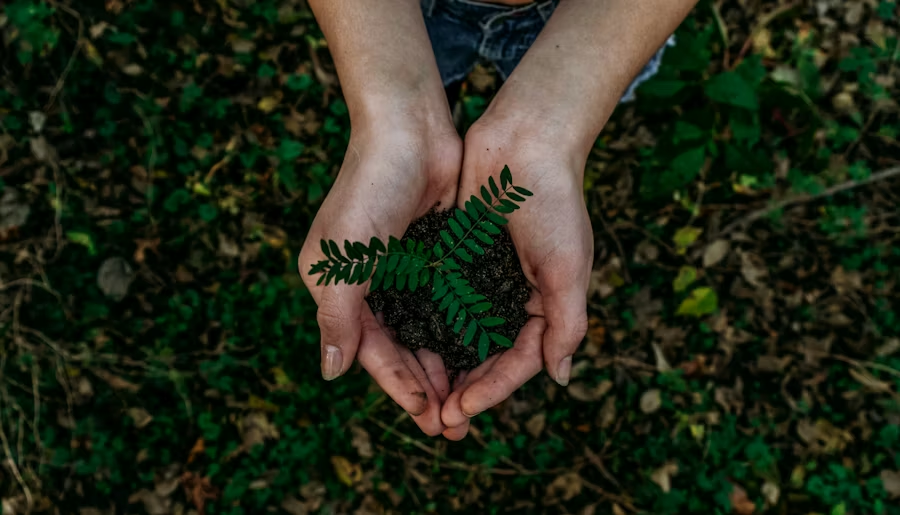
This makes post-Earth films the more troubling: planting seeds that forcefully push their way in and compete with those that inspire doing everything possible to heal, restore, sustain, and preserve this blue planet of ours, like the one planted by Project Hail Mary.
Wall-E
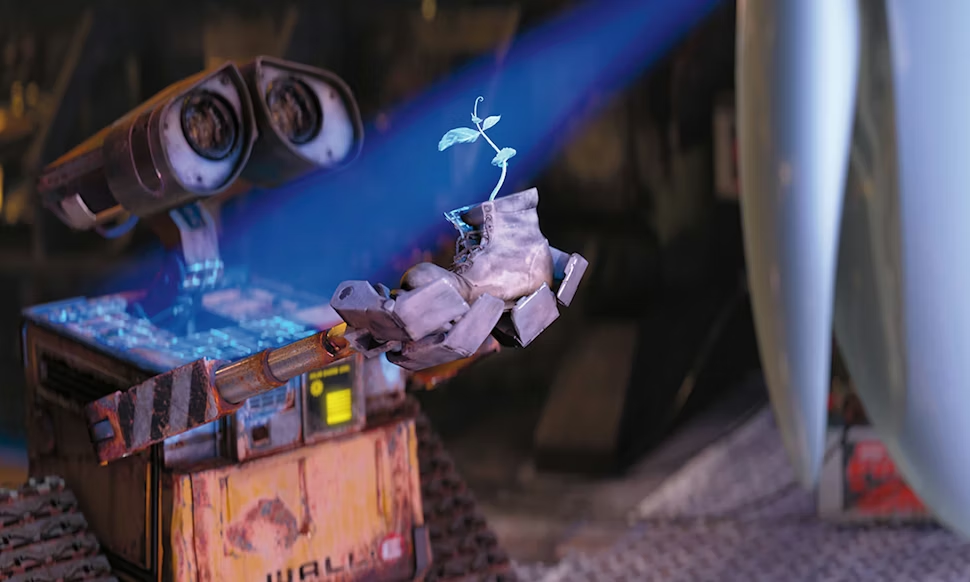
Pixar Animation's Wall-E (2008) [21] begins with a post-Earth scenario, when Earth becomes an abandoned garbage dump after human efforts fail to clean it up. While the ending is hopeful, the solution offered is to leave Earth to give time to some needed planetary R&R, same as Postcard from Earth (2023) by Darren Aronofsky, [9] made specifically for the 270° curved screen of the Sphere in Las Vegas.
Six years after Wall-E, Christopher Nolan's Interstellar (2014) [11] abandons Earth altogether. It opens with the Earth no longer able to sustain crops and scientists looking for solutions to go off-planet to save humanity. The film's opening begs the question: what failed attempts had been made to help restore Earth that led up to the point of no return, forcing people to figure out the best escape plan? A line or two of dialogue would have sufficed to give enough context to reframe the story from humans giving up on Earth to one where humans tried to save Earth but were now forced to leave.
More starkly contrasted is Neil Blomkamp's Elysium (2013), [14] where the wealthy humans have escaped to a pristine space habitat they built just beyond Earth's atmosphere, while the poor are left behind on an Earth ruined by pollution and disease. Elysium is a cautionary tale that highlights a classist solution to the problem of an increasingly uninhabitable Earth that is echoed in Don't Look Up (2021). [19]
Just coming out of the Covid-19 lockdown, the Netflix film [19] sharpens that critique into dark comedy: instead of dropping everything and looking beyond borders to address an extinction-level threat with the global community, the U.S. president alongside a billionaire tech bro still maintain their focus on profit, political polls, and saving only themselves, while the media keeps the rest of the population distracted, disengaged, or in outright denial of their imminent collective demise. Is there any hope for mankind?
Based on the novel by Andy Weir
Apparently yes. Six years in the making, Project Hail Mary (PHM) was the passion project of Ryan Gosling, who produced and starred in the film, and bought the rights to Andy Weir's novel before it was even published. [7] Unlike the films already mentioned, in PHM a small group of scientists are sent light years away on a necessarily one-way mission — not to escape but to save Earth.
United by the common goal to preserve Earth and humanity, scientists from around the world band together to share and discuss their findings, including Ryland Grace, the unwitting and unwilling hero of the story, played by Mr. Gosling. This is what one would hope would happen in the face of a global threat from space: for peoples and nations to see past human conflicts to work together to fight and defend against a common threat — when doing the right thing for the greater good trumps everything else.
The ingenuity, humility, and humanity of Ryland Grace is also testament to the strength of the human spirit to carry on at all costs. While Grace never agreed to go on the space mission, Dr. Eva Stratt saw something in him, and her instinct was ultimately the push he needed to save Earth. The urgency of the situation along with Dr. Stratt's unwavering faith in Grace gave him the drive to rise above his personal fears and doubts to meet the moment.
For when human wills align and unite, anything is possible. A quote from Roger Donaldson's Thirteen Days (2000) [3] sums it up: "We've got a bunch of smart guys. We lock 'em in a room and kick 'em in the ass until they come up with some solutions."
Indeed this is what happened during the Covid-19 pandemic. Researchers across institutions and borders raced to develop viable vaccines by openly sharing their research, allowing them to build on each other's findings.
The result: more than one working Covid-19 vaccine delivered in record time. Something that would have normally taken more than a decade to realize [22] was achieved within one year — arguably the fastest and most collaborative scientific mobilization in human history.
The pandemic clearly showed that people can transcend political borders and abandon normal protocol when the stakes are high enough. The question is: why wait until a catastrophe to find out the true worth of human mettle?
As art and reality reflect each other, the discussion of these films is also a commentary on the times we live in. Wall-E and Postcard from Earth are not wrong; Earth does need time to rest and recover, but maybe humans could be part of the solution, the assist that Earth needs.
From our shared global experience of the Covid lockdown, we saw how quickly Earth bounces back given the chance; a chance only humans can give. It is up to us to take the lockdown experience and adjust our relationship with the natural world, through changes in lifestyle and priorities that acknowledge human impact on the planet and aim towards a mutualistic symbiosis.
While Don't Look Up may eerily mirror most closely the current state of the world right now, change is in the air. Clearly it is not too late for Earth to heal, and technological innovation alone will not save us. In Project Hail Mary, all of humanity did not look to escape Earth but instead put their trust in a handful of scientists willing to sacrifice their own lives to save the lives of the many.
For the lives saved by Ryland Grace, as much as the lives currently living in this post-pandemic world, the question is not so much "What's the best exit strategy?" but more "Who must we become if we choose to stay?"
That would be a more difficult story to tell, as it is ours too, and thus the more necessary one.